Public research items and historical claims that have passed appropriate P1 evidence review; disputed claims remain explicitly labeled and are not treated as established fact.
民生观察(Minsheng Guancha;英文常译 Civil Rights & Livelihood Watch,CRLW)是由刘飞跃创办的独立民间人权信息平台,长期记录中国大陆基层维权、人权案件和社会抗争。其报道领域包括维权人士与律师案件、上访与拆迁纠纷、劳工与教师权益、宗教与信仰自由、警察滥权、政府腐败,以及活动人士和异议人士遭强制精神医疗收治等问题。
主要工作
收集并发布基层人权个案、访民与维权人士的一手或近一手信息;
持续记录拘押、判刑、失踪、监控与其他维稳措施;
报道劳工、农民、强拆受害者、教师、宗教群体等边缘或弱势群体的权益问题;
系统记录强制精神医疗收治问题;
自2014年前后起整理和发布年度人权与维稳相关报告。
历史与压力
Human Rights Watch记载,民生观察网站于2006年建立,并长期报道中国官方媒体通常无法自由报道的人权议题。创办人刘飞跃于2016年11月被湖北随州警方拘押,2019年1月29日被随州市中级人民法院以“煽动颠覆国家政权罪”判处有期徒刑五年。中国检方将其运营民生观察、发表人权报告及接受境外资助等事项列入起诉材料;国际人权组织则认为其遭判刑与其和平的人权监测、报道和倡议活动有关。
Li Wangyang (李旺阳, 1950–2012) was a Hunan labor activist associated with the independent workers’ movement that emerged around the 1989 democracy protests. He spent roughly two decades in prison after 1989 and was later described by Amnesty International as a prisoner of conscience.
After his release in May 2011, Li remained in extremely poor health. By June 2012 he was blind, nearly deaf, physically frail, and receiving treatment in a hospital in Shaoyang, Hunan. On June 6, 2012, he was found dead in his hospital ward. Local authorities described the death as suicide by hanging, but relatives immediately disputed that explanation.
Li Wangyang’s case connects three enduring human-rights concerns: punishment of independent labor organizing, long-term imprisonment and mistreatment of political detainees, and pressure on relatives who seek accountability. The unresolved questions surrounding his death became a major focus for activists in Hong Kong and overseas.
Fifty years after Mao Zedong’s death: remembrance, evidence and historical accountability.
September 9, 2026 — Fifty years after Mao Zedong’s death, China still lacks an open national accounting of the mass famine, political persecution and political violence associated with his rule.
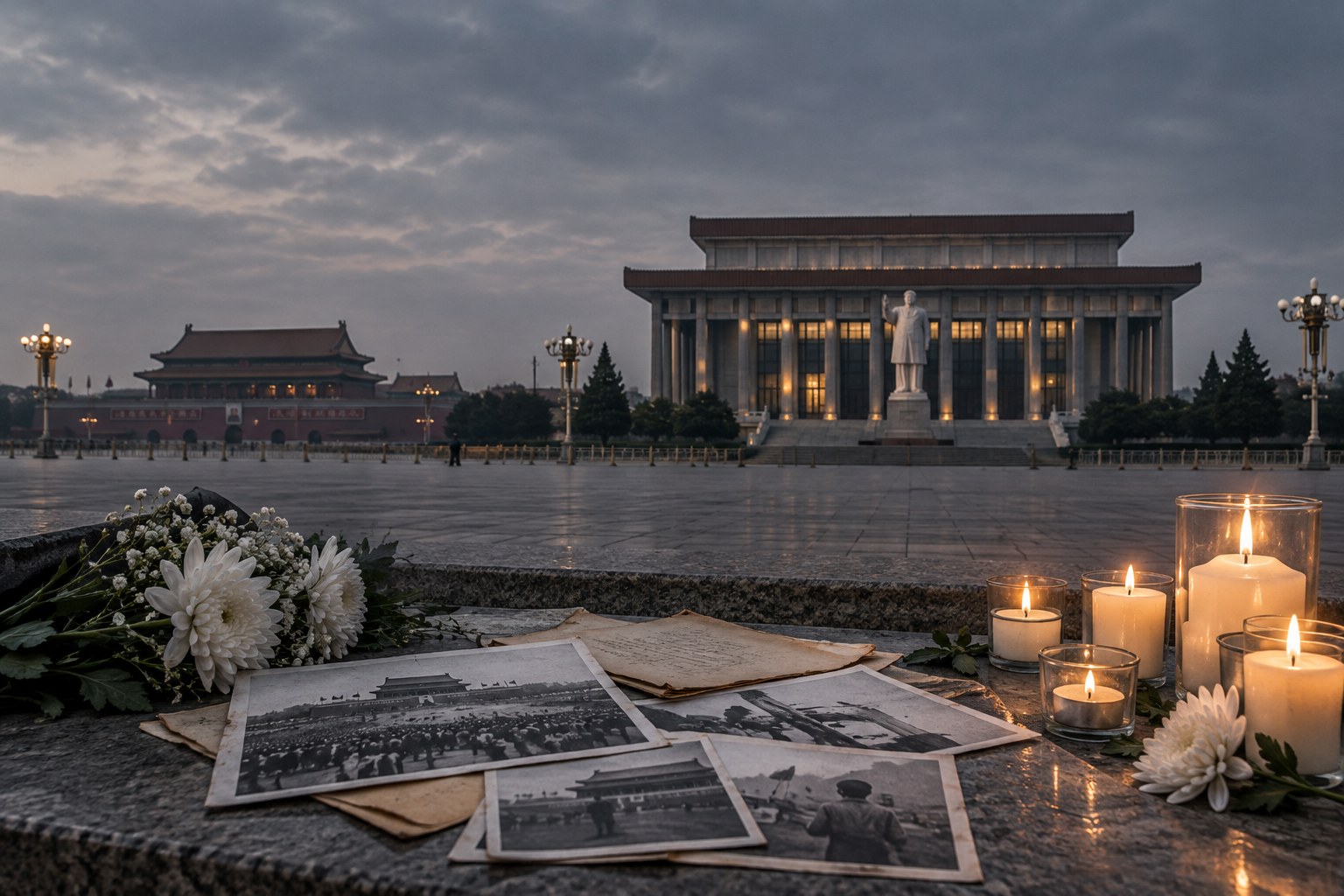
On the anniversary, Beijing’s Chairman Mao Memorial Hall extended its opening hours and reservations were fully booked. Reuters reported that Mao remains officially venerated even though the Chinese Communist Party’s own post-Mao historical judgment assigned him principal responsibility for the Cultural Revolution.
A record of famine and political persecution
The Great Leap Forward and the famine that accompanied it caused catastrophic mortality. Scholarly estimates differ, but research summarized by Stanford’s King Center places deaths from the 1958–1961 Great Famine at roughly 16.5 million to 30 million. The Anti-Rightist Campaign and other political campaigns punished intellectuals, officials, workers and citizens for criticism or alleged ideological disloyalty.
The Cultural Revolution brought mass persecution, imprisonment, torture, factional violence, killings and destruction of cultural and educational institutions. Research by Stanford sociologist Andrew Walder estimates roughly 1.1 million to 1.6 million deaths during the upheaval and suppression campaigns, while earlier work by Walder and Yang Su estimated that tens of millions in rural China experienced political persecution.
Remembering those who resisted
A complete historical record must also preserve the experiences of Chinese citizens, intellectuals, workers, students, officials, writers, religious believers, dissidents and families who at different times resisted political persecution, defended independent thought, documented abuses, protected victims or challenged Mao-era authoritarian practices and their continuation.
Historical accountability must distinguish among policy-makers, active perpetrators, coerced participants, bystanders and later officials. It should examine, on evidence, the institutions and individuals that enabled political campaigns, enforced persecution, concealed famine and mass suffering, or later preserved or revived authoritarian practices.
FCM calls for transformation of the Mao Memorial Hall
In a statement issued for the anniversary, the Free China Movement calls for the Mao Memorial Hall to cease functioning primarily as a site of political veneration and to be transformed into a national institution of historical accountability: a Hall of Shame and Historical Horror documenting Mao-era famine, persecution, forced labor, political violence and the experiences of victims and resisters.
The proposal calls for victims’ records, survivor testimony, a Great Leap Forward and famine archive, a Cultural Revolution museum, access to historical archives and evidence-based examination of responsibility. FCM argues that the purpose should be historical truth and public accountability rather than collective punishment.
The legacy after 1976
The political questions raised by Mao’s rule did not disappear with his death. Reuters reported on the anniversary that Mao-era ideology and symbolism continue to influence contemporary politics under Xi Jinping. A serious historical reckoning therefore must examine both Mao’s decisions and the institutions and political traditions that survived him in mainland China.
Sources
Reuters, September 9, 2026: “Mao, Cultural Revolution cast long shadow over China 50 years on.”
Beijing Municipal Government / Beijing Daily, September 7, 2026: Chairman Mao Memorial Hall anniversary opening and reservation notice.
Stanford King Center research on mortality during the Great Famine.
Andrew G. Walder and Yang Su, research on the Cultural Revolution’s human impact, Stanford University.
Fifty years after Mao’s death, historical memory must center victims, evidence and accountability.
September 9, 2026 — The fiftieth anniversary of Mao Zedong’s death should not be treated merely as an anniversary of a former ruler. It should be a national reckoning with the enormous human cost of political campaigns carried out under his leadership and with the institutions and political habits that survived him.
The Great Leap Forward and ensuing famine killed millions. The Anti-Rightist Campaign destroyed careers, families and lives. The Cultural Revolution brought political persecution, torture, imprisonment, public humiliation, factional violence, killings and the destruction of cultural and educational institutions. The central historical question is therefore not whether Mao remains symbolically important, but why the public memory of these catastrophes remains constrained while his state-sponsored veneration continues.
Victims and resisters must be at the center
A truthful national history must honor those who resisted persecution: citizens, intellectuals, workers, students, officials, writers, religious believers, dissidents and families who defended independent thought, protected victims, preserved records, challenged political violence or refused to participate in persecution. Their testimony, diaries, petitions, underground publications, photographs and local records should be preserved as part of China’s national memory.
Those acts of conscience matter because Mao-era repression depended not only on directives from the top, but on institutions and networks of enforcement. Historical accountability should identify, on evidence, those who designed, enabled, administered or concealed abuses, while distinguishing policy-makers and active perpetrators from coerced participants, bystanders and people who tried to protect others.
The legacy did not end in 1976
The Free China Movement argues that Mao’s political legacy did not disappear with his death. Censorship, political conformity, repression of dissent, personality-centered rule and concentration of unchecked power persisted in different forms in mainland China. Later leaders and institutions that preserved or revived such practices should be examined openly and judged by the same standards of evidence and individual responsibility.
That is not collective condemnation of generations of Chinese people. It is a demand that no institution or political leader be exempt from scrutiny merely because the ruling system treats parts of its own history as politically untouchable.
Transform the Mao Memorial Hall
For that reason, the Free China Movement supports transforming the Chairman Mao Memorial Hall in Tiananmen Square from a site of political veneration into a Hall of Shame and Historical Horror dedicated to the victims of Mao-era famine, forced labor, political campaigns and political violence.
The transformed institution should contain a national victims’ memorial, a Great Leap Forward and famine archive, a Cultural Revolution museum, an archive of resistance and conscience, an accountability archive examining decision-making and institutional responsibility, and open access for researchers and victims’ families.
This proposal is not about erasing Mao from history. It is about ending the privilege of a state-sponsored personality cult and replacing it with evidence, testimony, remembrance and accountability.
A democratic standard for historical reckoning
A future democratic China should not replace one compulsory historical narrative with another. It should protect evidence, permit peaceful disagreement and ensure that no government can punish historical inquiry or suppress victims’ testimony. The purpose of accountability should be truth, individual responsibility based on evidence, institutional reform and safeguards against recurrence — not collective punishment.
Fifty years after Mao’s death, the victims deserve more than silence. Those who resisted persecution deserve recognition. Those who enabled grave abuses should be subject to historical scrutiny. And the political practices inherited from Maoism should no longer be insulated from open public judgment.