Policy research article — 2026-09-23. Evidence base: Liu Shougang, 《财政中国三千年》 (highlighted passages, pp. 34, 117, 209–210, 216); ROC (Taiwan) fiscal and civil-service practice since the 1950s; comparative cases (UK, US, Meiji Japan, South Korea, New Zealand, Singapore). Evidence grading: VERIFIED / PROBABLE / UNVERIFIED per source. Numbers on a future PRC transition are UNVERIFIED estimates — targets are given as benchmarked ratios and methods, not asserted facts.
1. Thesis
Imperial China did not fail at fiscal reform for lack of ideas. It failed because three structural traps were never escaped: (1) Revenue was pushed onto heads instead of capacity — when the Han cut the land tax (三十税一), the shortfall was made up with head taxes (算赋/口赋/更赋); in Wang Mang’s phrase: “其名三十,实十税五也” — nominally 1/30, effectively 1/2. Head taxes fall hardest on those with the least; the landless fled; “最终,流民毁掉了大汉帝国” — in the end, the drifters destroyed the Han empire. (2) The bureaucracy was a loyalty-purchase machine: Song “养官” policy plus the rank/post (阶官/职官) separation produced 官多阙少 — more officials on the payroll than posts to fill. (3) No fiscal constitutionalism existed: Wang Anshi’s reforms demanded secure property rights, rule of law, market intermediaries, spending discipline (the break from 量入为出), and officials accountable to the people — “由民众决定官吏的去留” — i.e., democracy. Add the fourth defect: privilege destroyed fiscal equality, and budgeting ran on 基数法 (incremental “base-plus” budgeting).
A future free China must therefore constitutionalize the solutions: a ban on head taxation, capacity-based taxation, a legally binding staffing ceiling, performance-based administration, and enforceable fiscal rules. Every one of these has a working precedent — most directly in the Republic of China’s own practice on Taiwan since the 1950s.
Related on this site: the Governance section’s Historical Chinese Policy & Democratic Responses series, which preserves China’s major policy decisions and the democratic, civic, and scholarly responses they drew.
2. The historical findings (from the source text)
2.1 The head-tax trap (Han, p. 117) — VERIFIED from text
When the formal land tax proved insufficient, the state “不得不转向税人或者税商” — had to turn to taxing people or commerce. Head-tax revenue eventually “远远超过了田赋” (far exceeded the land tax). Once land circulated and peasants lost land, they had no income to pay the head tax — so they fled, and vagrancy destabilized society. A flat levy on persons converts economic distress into political destabilization.
2.2 The bloated officialdom (Song, pp. 209–210) — VERIFIED from text
Song official salaries were the empire’s second-largest expenditure after the military. Causes: many gates of entry (科举, 荫补, 军功, 买官…) and the rank/post separation — “形成官多阙少的现象”. The precise imperial analogue of today’s “编制 vs. 实有人数” gap.
2.3 Why Wang Anshi could not succeed (p. 216) — VERIFIED from text
No property-rights foundation (the Green Sprouts lending program 青苗法 degenerated into “赤裸裸的权力压榨” — naked power extraction); spending broke 量入为出; accountability requires the people deciding officials’ retention — “这实际上对民主制度提出了要求”.
2.4 Privilege and budgeting (p. 34) — VERIFIED from text
Imperial power itself was a privilege rooted in land and hereditary succession; legal and extralegal privilege → land annexation (兼并) and monopolies → erosion of the tax base. Proper management should run 以支定收 (zero-based logic); Ming-Qing practice was 基数法.
3. ROC practice since the 1950s: the counter-model that worked
3.1 Tax people never; tax capacity always
Land reform (1949–1953) taxed and redistributed land value, never heads. The 1951 Uniform Invoice Lottery: tax collection rose 75% in one year (NT$29M → NT$51M) with no rate hikes — compliance is a design problem. Taiwan’s tax-to-GDP ratio stayed at 11–15% since 2000 (14.7% in 2024 — VERIFIED, the highest in 26 years; 20.5% including social security in 2023 — vs. Korea 28.9%, Japan 34.4%). Direct taxes are ~70% of revenue. The 1960 Statute for Encouragement of Investment drove the miracle, then was allowed to expire (1990) — incentives with end dates.
3.2 Staffing: the cap — and the loophole that teaches the real lesson
The 2010 Central Government Agency Total Staffing Cap Act set a hard ceiling of 160,000 central personnel. The 2012 reorganization cut 37 ministries/commissions to 29 agencies (−9,386 authorized posts). The loophole: by 2014, unbudgeted staff reached 33,715 — 24.2% over the budgeted complement — with ~94,000 temporary/dispatch workers outside the cap entirely. Design rule: the cap must cover every employment form, or agencies will arbitrage it. The appraisal failure: ~75% of civil servants received the top rating for a decade; 0–4 dismissals per year out of 260,000. Lifetime tenure plus Lake-Wobegon appraisals = the Song 冗官 problem in modern dress.
4. How other countries resolved the same problems
4.1 Head taxes: tried in modern times, failed everywhere
UK 1989–1993: Thatcher’s Community Charge (flat ~£180 per adult) → mass non-payment, the Trafalgar Square riot of 31 March 1990 (113 injured, 340 arrested), £1.2 billion uncollected in year one, Thatcher’s resignation; replaced 1993 by property-banded Council Tax. US: poll taxes abolished by the 24th Amendment (1964) and Harper v. Virginia (1966). Meiji Japan 1873 (地租改正): replaced in-kind rice tribute with a cash tax of 3% of assessed land value (cut to 2.5% after protests), on a national cadastral survey (1873–1882) issuing 100M+ ownership certificates — revenue stabilized while most farmers’ burden fell, creating the property-rights foundation Wang Anshi lacked.
4.2 Bureaucratic downsizing: the 20–47% precedents
South Korea 1998–2001: total public-sector employment −20% in four years (central −22,000; local −57,000; SOEs/affiliates −62,000); civil service back below its 1992 level; ministries 22→17; 74 SOEs privatized; by 2002 Korea had the lowest civil-servant-to-population ratio in the OECD. New Zealand 1987–1992: core public service 89,000 → 47,000 (−47%); State Sector Act 1988, Public Finance Act 1989 (accrual accounting, output budgeting), Fiscal Responsibility Act 1994 (legally binding fiscal principles — the modern form of 量入为出). Singapore: ~2 public employees per 100 inhabitants; a 1986 directive cut 10% over five years via replacement-only hiring; PS21 (1995) continuous improvement.
4.3 The normalized comparison: PRC vs ROC vs OECD, 1980–2025
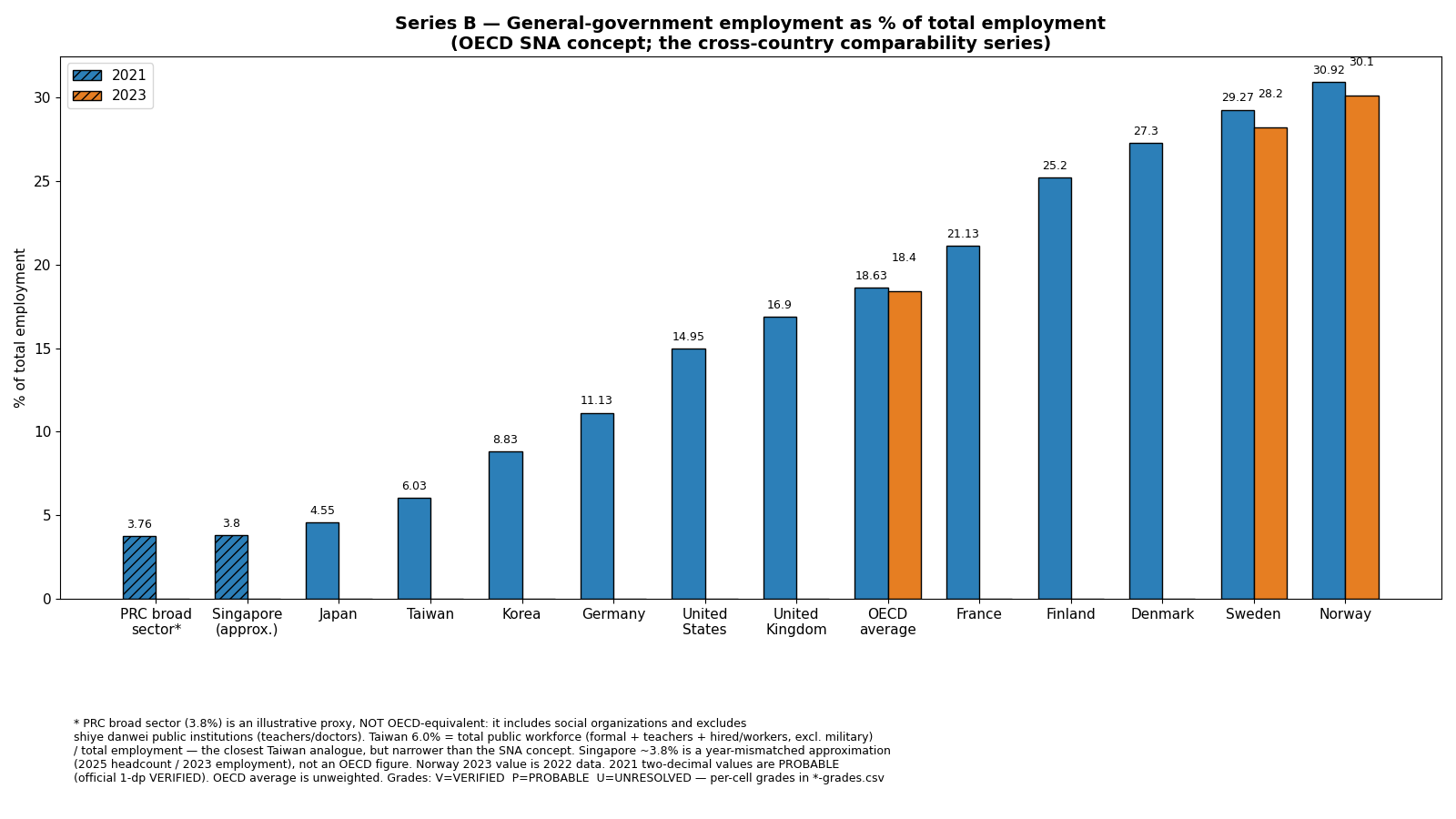
The most common error — dividing the PRC’s narrow 公务员 count (7.167M, end-2015) by total employment and comparing with the OECD’s 14.95% US figure — is a category error. Three benchmark-year series (1980/1990/2000/2010/2015/2020/2023/2024–25; empty cells = no data, nothing invented):
Series B — broad public workforce, % of total employment (the OECD-comparability chart):
| Economy | 2021 | 2023 |
|---|---|---|
| Norway | 30.9 | 30.1 |
| Sweden | 29.3 | 28.2 |
| Denmark | — | 27.3 |
| Finland | — | 25.2 |
| France | 21.1 | — |
| OECD average | 18.6 | 18.4 |
| UK | 16.9 | — |
| US | 15.0 | — |
| Germany | 11.1 | — |
| Korea | 8.8 | — |
| Taiwan | — | 6.0 |
| Japan | 4.6 | — |
Taiwan’s total public workforce is 6.03% of total employment (2023; excludes military) — one-third of the OECD average. PRC rows are recorded separately with non-equivalence labels: narrow civil servants 0.93% (2015) and broad official-sector proxy 3.76% (2023) — the latter includes social organizations and still excludes most 事业单位, so it is NOT OECD-comparable. Singapore ≈3.8% (approximation).
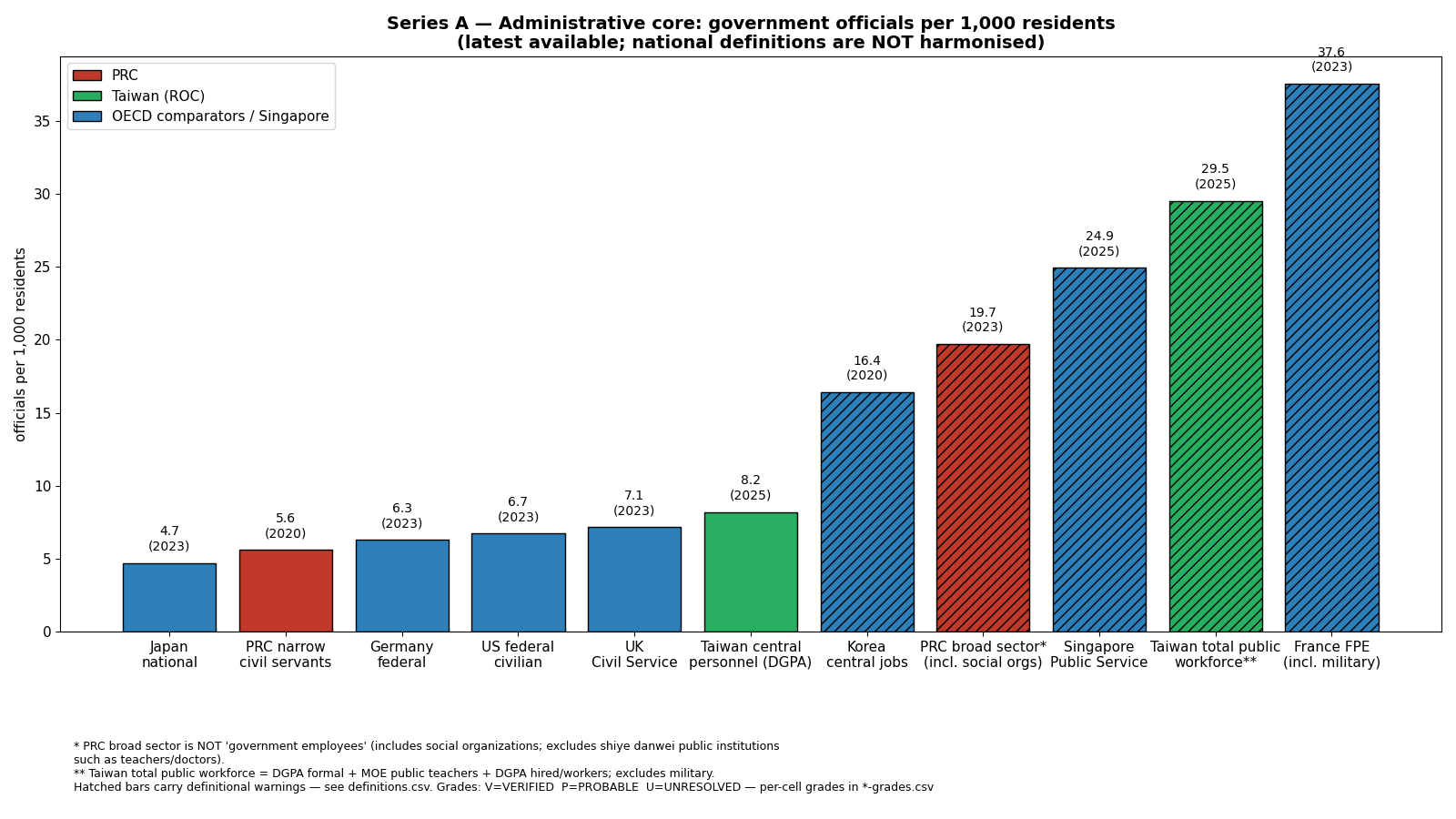
Series A — administrative core, per 1,000 residents:
| Economy (national definition) | Per 1,000 residents | Year |
|---|---|---|
| France (incl. military) | 37.58 | — |
| Taiwan total public workforce | 29.53 | 2025 |
| Singapore | 24.95 | — |
| PRC broad official-sector proxy | 19.71 | 2023 |
| Korea central jobs | 16.41 | — |
| Taiwan central formal personnel | 8.18 | 2025 |
| UK Civil Service | 7.14 | — |
| US federal civilian | 6.71 | — |
| Germany federal | 6.28 | — |
| PRC narrow civil servants | 5.19 | 2015 |
| Japan national | 4.68 | — |
Each row uses its national definition; trends and orders of magnitude are the signal. Taiwan total public workforce = 2.95% of population (2025).
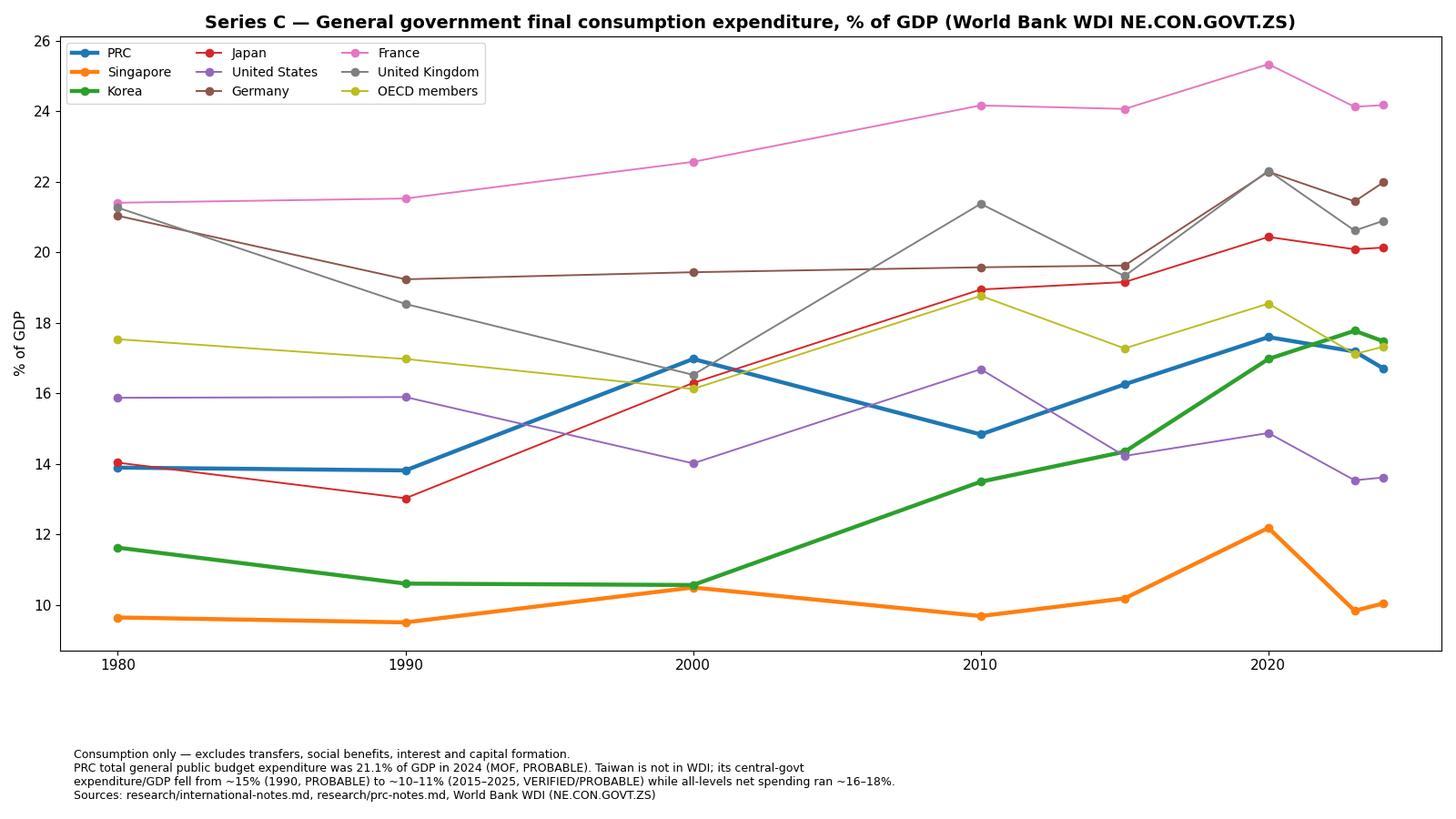
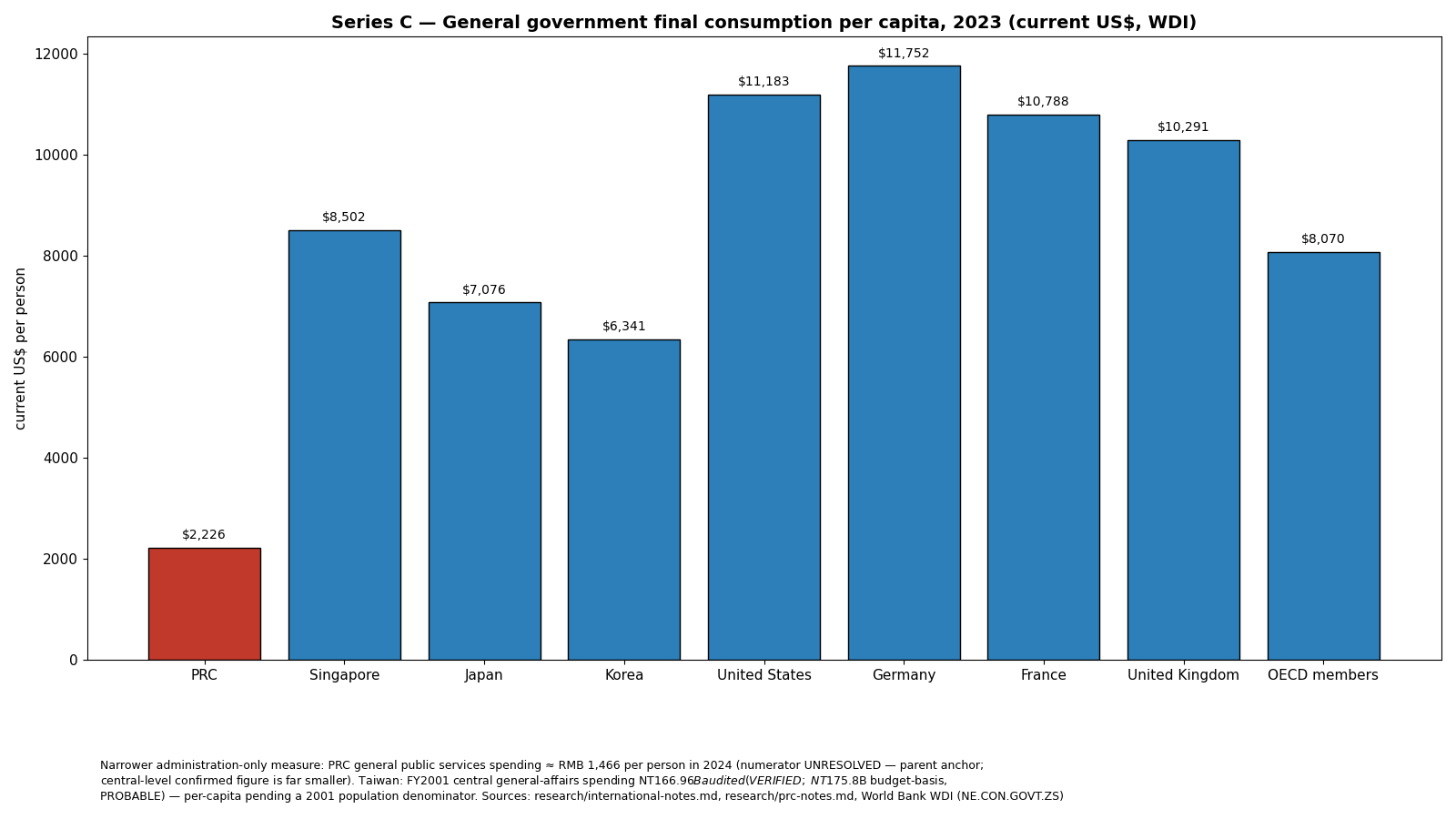
Series C — fiscal burden: World Bank standardized series (general-government final consumption, % of GDP, 1980–2024, all nine economies); PRC total general public budget expenditure 21.1% of GDP (2024); PRC 一般公共服务支出 RMB 2.065T actual 2024 (one functional category only); Taiwan central-government expenditure ~15.0% of GDP (1990) → 10.2% (2020), 10.5% on 2025 budget basis (all-levels net ~16–18%); Taiwan’s tax burden 14.7% of GDP in 2024 (corrected from 14.8% in an earlier draft — the earlier figure was unsupported) and 20.5% with social-security contributions (2023, VERIFIED); Korea 28.9% and Japan 34.4% (2023, tax including social security).
What the normalization establishes:
- the Song-style headcount illusion is structural to PRC statistics — the narrow figure understates the publicly-financed workforce by roughly 4× (27.8M vs 7.2M);
- Taiwan is a genuine lean-state outlier even within the OECD frame — 6.0% vs 18.4% average;
- the lean state makes the low tax burden possible: 14.7% tax/GDP is roughly one-half of Korea’s and one-third of France’s;
- Korea and Japan prove democratic states can deliver modern services below 10%.
5. Policy options for a future free China (presented without ranking; analytical inference, not fact)
Option 1 — Constitutional ban on head taxation
No tax, fee, levy, or social-insurance contribution at a flat per-person amount unrelated to income, wealth, consumption, or land value. Precedents: US 24th Amendment; the UK’s 1990–93 verdict. Risk: drafting must not accidentally outlaw legitimate flat fees (e.g., court filing fees).
Option 2 — Capacity-based tax architecture
Land/property value as the base — complete a national cadastral survey and registered titling BEFORE setting rates (Meiji sequencing, 1873–1882); tax assessed value in cash at low uniform rates. Progressive income tax + VAT on the Taiwan model: total tax/GDP in the 12–18% band. Compliance by design: nationwide uniform e-invoicing with a receipt lottery (Taiwan 1951: attributed +75% revenue, zero rate hikes — primary confirmation still needed). Sunset every incentive with statutory expiry dates (Taiwan’s 1960 statute model). Risk: PRC state ownership of land is a transition problem Meiji did not face.
Option 3 — Enforceable fiscal rules
Constitutionalize 量入为出 as a debt brake: structural deficit ceiling, binding multi-year expenditure frameworks, accrual accounting, output budgeting (New Zealand’s 1989/1994 model); replace 基数法 with rotating zero-based reviews and sunset defaults. Risk: NZ’s reforms produced documented fragmentation and short-termism — guardrails needed; rigid rules need crisis escape clauses.
Option 4 — Census-first staffing reform with evidence-anchored ceilings
Step zero: a comprehensive personnel census (budgeted + 事业编 + temporary + dispatched + seconded + SOE-affiliated). Then, as policy judgments (not facts): total public employment ≤3% of population — Taiwan’s real level is 2.95% (29.53/1,000, 2025), so this ceiling has a working proof; central government ≤0.7% — Taiwan’s 2010 cap ratio was 0.68%, though Taiwan’s own central headcount has drifted to 0.82% (2025), which is the argument for a statutory, binding cap. First-term cut of 20–25% of general-administrative positions over 4–5 years (Korea’s −20% and NZ’s −47% define the feasibility envelope). End the rank-without-post system: no salary without an occupied, budgeted post. The cap must cover ALL employment forms by statute — the Taiwan 2010–2014 loophole must be closed on day one. Cut positions, protect people: attrition + hiring freezes + early retirement + retraining into understaffed frontline services, not mass layoffs (the Korea/NZ mechanism that kept reform survivable). Privatize/corporatize commercial functions out of the core civil service. Risk: Korea’s cut was crisis-enabled; a non-crisis transition needs its own political-economy strategy.
Option 5 — Democratic accountability and productivity program
Performance contracts for agency heads (NZ “purchase agreements”); published output metrics; elected-legislature confirmation/removal powers over senior appointments; a legally workable dismissal track for sustained poor performance (the reform Taiwan attempted in 2010 and failed to pass); open-competition senior posts (Korea 1999); market-benchmarked pay after consolidation (Singapore); end-to-end digital services with a budgeted headcount dividend for every digitized workflow; asset disclosure, procurement transparency, revolving-door cooling periods. Risk: the 2010 Taiwan dismissal-reform failure shows the first-mover political cost is real.
Option 6 — Sequencing: the Han lesson, inverted
(1) census + land/property registration; (2) capacity-based taxes + e-invoicing — revenue first; (3) fiscal rules legislated; (4) function review and staffing cuts funded by the fiscal space; (5) productivity/digital reforms locked in. Never cut taxes before the replacement revenue instrument is operating — that is the precise Han error. Risk: crisis contexts may force parallel rather than sequential reform.
6. Disagreements and risks
- D-1 Crisis-enablement: Korea’s −20% and NZ’s −47% both rode crises; replicability in a managed transition is disputed.
- D-2 NZ fragmentation/short-termism: efficiency gains came with documented institutional costs.
- D-3 PRC state land ownership vs Meiji private titling: the land-tax base faces a transition problem with no precedent in the comparison set.
- D-4 Definitional politics: any staffing ceiling will be gamed via off-budget employment forms unless the cap statute names them all (the Taiwan 2010–2014 lesson).
7. Positions and inference — clearly distinguished
(a) Documented historical facts
The four historical findings (§2), the normalized comparison series (§4.3), Taiwan’s published fiscal and staffing record (§3), and the comparative case outcomes (§4.1–4.2), each with evidence grades.
(b) PRC official position
Published statistics only (see §4.3). There is no official PRC position on a fiscal constitution for a future free China; none is inferred.
(c) Named scholar and dissident positions
Charter 08 (2008), item 15 of its 19 recommendations, demands 财税改革 (financial and tax reform) — specifics not elaborated in the charter. (See this site’s Charter 08 Civic Initiative historical archive.) Wang Tiancheng’s constitutional-design proposals are a related research pointer; no specific fiscal provision is attributed here. No other stances are attributed.
(d) International comparisons
OECD Government at a Glance employment shares; World Bank standardized government-consumption series; NZ Fiscal Responsibility Act 1994 as the legislated 量入为出 analogue.
(e) Free China Movement organizational position
Free China Movement organizational position: The Free China Movement advocates cuts in international givings, lower military costs, and reductions in administrative payroll and head counts to match the ROC (Taiwan) level today — so as to lower taxes for most of the middle class and below, ensure an adequate welfare budget for the weak, and raise education spending to above the average international standard, with plans to increase the percentage each year.
(f) Inference
The six options in §5 are analytical inference from the evidence, presented without ranking.
8. Limitations and open research
- PRC-side personnel and fiscal numbers: 7.167M civil servants = PROBABLE (NCSA primary release not located); 27.811M broad sector = UNRESOLVED (official NBS table not located); both labeled non-equivalent to the OECD series. All cut targets are ratios/methods pending a census.
- Taiwan’s experience is a small-island, export-led case; scaling to continental China needs dedicated modeling.
- The land-value tax design must handle the PRC’s state-ownership-of-land regime.
- Estonia-style digital-government claims lack researched sourcing in this package.
Open research items:
- R-A continental-scale modeling;
- R-B land-tax transition design;
- R-C non-crisis cut strategy;
- R-D NZ-style guardrails;
- R-E head-tax-ban drafting precision;
- R-F receipt-lottery primary confirmation;
- R-G debt-brake escape clauses.
简体中文版:永不再有人头税:两千年中华财政失败给未来自由中国的教训。