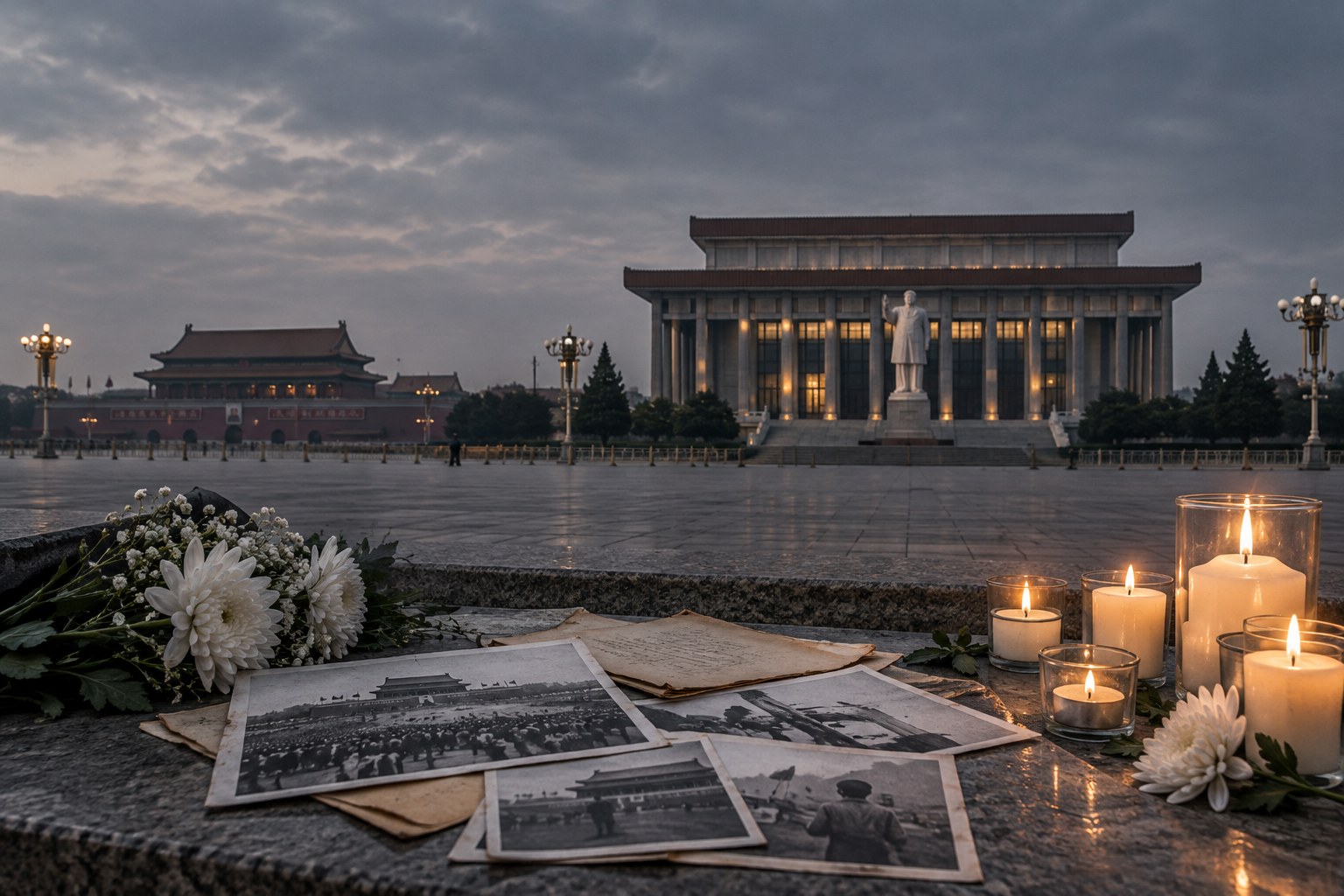
September 9, 2026 — Fifty years after Mao Zedong’s death, China still lacks an open national accounting of the mass famine, political persecution and political violence associated with his rule.
On the anniversary, Beijing’s Chairman Mao Memorial Hall extended its opening hours and reservations were fully booked. Reuters reported that Mao remains officially venerated even though the Chinese Communist Party’s own post-Mao historical judgment assigned him principal responsibility for the Cultural Revolution.
A record of famine and political persecution
The Great Leap Forward and the famine that accompanied it caused catastrophic mortality. Scholarly estimates differ, but research summarized by Stanford’s King Center places deaths from the 1958–1961 Great Famine at roughly 16.5 million to 30 million. The Anti-Rightist Campaign and other political campaigns punished intellectuals, officials, workers and citizens for criticism or alleged ideological disloyalty.
The Cultural Revolution brought mass persecution, imprisonment, torture, factional violence, killings and destruction of cultural and educational institutions. Research by Stanford sociologist Andrew Walder estimates roughly 1.1 million to 1.6 million deaths during the upheaval and suppression campaigns, while earlier work by Walder and Yang Su estimated that tens of millions in rural China experienced political persecution.
Remembering those who resisted
A complete historical record must also preserve the experiences of Chinese citizens, intellectuals, workers, students, officials, writers, religious believers, dissidents and families who at different times resisted political persecution, defended independent thought, documented abuses, protected victims or challenged Mao-era authoritarian practices and their continuation.
Historical accountability must distinguish among policy-makers, active perpetrators, coerced participants, bystanders and later officials. It should examine, on evidence, the institutions and individuals that enabled political campaigns, enforced persecution, concealed famine and mass suffering, or later preserved or revived authoritarian practices.
FCM calls for transformation of the Mao Memorial Hall
In a statement issued for the anniversary, the Free China Movement calls for the Mao Memorial Hall to cease functioning primarily as a site of political veneration and to be transformed into a national institution of historical accountability: a Hall of Shame and Historical Horror documenting Mao-era famine, persecution, forced labor, political violence and the experiences of victims and resisters.
The proposal calls for victims’ records, survivor testimony, a Great Leap Forward and famine archive, a Cultural Revolution museum, access to historical archives and evidence-based examination of responsibility. FCM argues that the purpose should be historical truth and public accountability rather than collective punishment.
The legacy after 1976
The political questions raised by Mao’s rule did not disappear with his death. Reuters reported on the anniversary that Mao-era ideology and symbolism continue to influence contemporary politics under Xi Jinping. A serious historical reckoning therefore must examine both Mao’s decisions and the institutions and political traditions that survived him in mainland China.
Sources
- Reuters, September 9, 2026: “Mao, Cultural Revolution cast long shadow over China 50 years on.”
- Beijing Municipal Government / Beijing Daily, September 7, 2026: Chairman Mao Memorial Hall anniversary opening and reservation notice.
- Stanford King Center research on mortality during the Great Famine.
- Andrew G. Walder and Yang Su, research on the Cultural Revolution’s human impact, Stanford University.